A magnifying glass has a focal length of 10 cm. Put a small object u centimetres in front
of it. The thin-lens equation u1+v1=101 says where the lens
forms the sharp image of the object: at distance
behind the lens, for every u=10, in centimetres. (A negative v means that the image is
on the same side as the object: the enlarged virtual image you see when you look through the
glass.) What happens as the object moves towards the focal point, u=10?
u
11
10.1
10.01
9.99
9.9
v(u)
110
1010
10010
−9990
−990
From the right, the image runs away behind the lens: 10.01 cm gives an image 100 metres
away. From the left, the virtual image runs away just as fast on the other side. So v(u)
approaches no number as u approaches 10 from either side. On the page
The Limit of a Function such behaviour was one of the ways a limit can fail to
exist (compare its example of unbounded values, x21
near 0). But “does not exist” throws away what we see in the table: on the right the values
grow beyond every bound, and on the left they fall below every bound.
This page gives that behaviour a notation, limu→10+v(u)=∞ and
limu→10−v(u)=−∞, and a precise meaning. The notation does not make ∞
a number: we prove that such a limit does not exist as a real number. Then we find infinite
limits of rational functions by a sign analysis, and the lines they create in the graph, the
vertical asymptotes. Example 4 proves the two limits of the table, and
finds how close to 10 cm the object must be for the image to be more than 10 metres away.
Informally, limx→a+f(x)=∞ means that f(x) is as large as we like for all
x close enough to a and greater than a. The game of
the definition of one-sided limits changes in one place: instead of
a band of half-width ε around a number L, the challenger names a height M, and the
values of f on the half-window must lie above it.
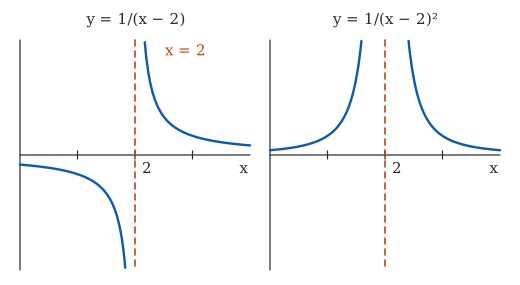
Figure 1:Left: y=x−21 climbs beyond every height as x approaches 2 from the right, and
falls below every height as x approaches 2 from the left. Right: y=(x−2)21
climbs beyond every height from both sides. The dashed line x=2 is a vertical asymptote of
both graphs. A drawing shows finitely many points; Proposition 2
proves what it suggests.
“Close enough” means the same as in the definition of one-sided
limits: there is a half-window a<x<a+δ (or
a−δ<x<a) on which it holds. The rigorous track states this precisely, in the
dropdown below; the proofs on this page use that version.
(a) Let f be as in part (a) of Definition 1. Then
limx→a+f(x)=∞ means: for every M>0 there is a δ>0 such that f
is defined at every x with a<x<a+δ, and
And limx→a+f(x)=−∞ means the same with f(x)<−M in place of f(x)>M.
(b) Let f be as in part (b) of Definition 1. The statements
limx→a−f(x)=∞ and limx→a−f(x)=−∞ mean the same as in
(a), with the half-window a−δ<x<a in place of a<x<a+δ.
Part (c) of Definition 1 is defined through (a) and (b), so it needs no
precise version of its own.
In words. A challenger names a height M>0; you reply with a half-window of width
δ next to a; you win the round if f is defined at every x of the half-window and
every such f(x) is above M. The limit is ∞ when you can win every round. Three
points to notice:
δ is chosen after M, so it may depend on M (and on a), but not on x. A higher
M usually needs a narrower half-window. If a δ wins a round, so does every smaller
δ>0, and it wins every lower height too.
Neither half-window contains a. The value f(a), and whether it exists, plays no part.
“=∞” is notation, not an equation between numbers: ∞ is not a real number,
and there is no band around it. It says howf(x) fails to approach a number.
Proposition 1 below proves that it does fail.
Example.limx→0+x1=∞. The function x1 is defined
at every x=0. Given M>0, take δ=M1, which is positive by
property 6 of the order rules. If 0<x<M1, then by the
same property 6 (0<u<v implies v1<u1, with u=x and
v=M1), M=1/M1<x1.
Non-example.limx→0−x1 is not ∞. Take M=1. For x<0,
x1 has the sign of x (part (c) of the sign rules), so
x1<0<1. So every point of every half-window −δ<x<0 fails the round
M=1, and no δ wins it. (From the left, x1 tends to −∞:
Proposition 2 below.)
An infinite limit at a shows in the graph of f as a vertical line that the graph climbs or
falls along without bound, as the line x=2 in
Figure 1.
In words. On at least one side of the line x=a, the graph of f climbs beyond every
height or falls below every height as x approaches a. One side is enough, and the two sides
may go in different directions. As with every limit, the value f(a) plays no part: f may be
defined at a and still have the vertical asymptote x=a. For example,
F(x)=x1+1 for x>0 and F(x)=0 for x≤0 is defined at 0, and
limx→0+F(x)=∞: for x>0, adding x1 to 0<1 gives
x1<F(x) (property 3 of the order rules), so by
transitivity (property 2) the δ=M1 of the example above wins every round M
for F too.
Example. The line x=0 is a vertical asymptote of the graph of x1, by the
example after Definition 2.
Non-example. Let g(x)=x−1x2−1 for x=1. Although g is undefined at
1, the line x=1 is not a vertical asymptote of its graph. For x=1 we may cancel the
non-zero factor x−1, so g(x)=x+1. If 0<x<2, adding 1 keeps both inequalities
(property 3 of the order rules): 1<g(x)<3 for every x=1 in
(0,2). Take M=3. Every half-window 1<x<1+δ contains the point
x=1+21min(δ,1), which lies in (1,2), so g(x)<3=M there: no δ
wins the round M=3, and limx→1+g(x)=∞. At the same point
g(x)>1>−3, so limx→1+g(x)=−∞ either, and the point
x=1−21min(δ,1) of the left half-window does the same from the left. A
function that stays between two numbers near a has no vertical asymptote at a.
If f(x) is above every height near a, it cannot also stay within 1 of a fixed number
L, because L+1 is one of the heights.
In words. “limx→af(x)=∞” is a precise way of saying that the limit does
not exist: it records the reason. The converse is false. A limit can fail to exist without
being ∞ or −∞: at a jump, such as x∣x∣ at 0, or when the two sides
go to different infinities, as x1 does at 0 (Proposition 2
below), so that limx→0x1 is neither ∞ nor −∞, by part (c) of
Definition 1.
The simplest infinite limits are those of (x−a)n1. Their sign depends on the side
and on whether n is even or odd (Figure 1).
So for every n≥1 the line x=a is a vertical asymptote of the graph of
(x−a)n1. For odd n the one-sided limits are ∞ and −∞, and
limx→a(x−a)n1 is neither, by part (c) of Definition 1.
Near a zero a of its denominator, after cancelling common factors, a rational function is a
reciprocal power (x−a)k1 times a factor h(x) that does not vanish at a. If h keeps one sign
and stays a fixed distance away from 0 near a, it cannot stop the reciprocal power from
growing; it can only flip its sign.
In words: how to find the one-sided limits of a rational function at a zero a of its
denominator.
Factor the numerator and the denominator. If the numerator is also 0 at a, cancel the
common factor x−a first: for x=a the two expressions are the same number. What is
left may have a finite limit at a (Example 3).
Sign. By the proposition on the sign of a factored rational
function, f has one sign on the interval just to the right of a
and one just to the left (up to the next number of a linear factor). These signs tell you which
of ∞ and −∞ to expect on each side.
Split. On a window around a, write f(x)=h(x)⋅(x−a)k1, where k is
the number of factors x−a in the denominator. This is algebra at each point x=a of
the window, not a statement about limits.
Bound. Choose the window so small that it contains no other number of a linear factor,
and find an m>0 with h(x)≥m (or h(x)≤−m) at every point of it, with
the order rules.
Proposition 3 asks for h(x)≥m with a fixed m>0, not only
h(x)>0. That is needed. Let h(x)=x2 and g(x)=x1 for 0<x<1. Then
h(x)>0 and limx→0+g(x)=∞, but h(x)g(x)=x is less than 1 at every
point of (0,1), so no δ wins the round M=1 for it, and it does not tend to ∞.
The values of h come arbitrarily close to 0, and they beat the growth of g. In the same way,
part (c) needs L=0: with h(x)=x, which tends to 0, the product h(x)g(x)=1 is
constant.
Unbounded is not the same as tending to ∞
A function can take values beyond every height in every half-window, and still not tend to
∞. For x>0, let k(x) be the integer part of x1,
and let f(x)=x1 if k(x) is even and f(x)=0 if k(x) is odd.
Let δ>0. By the Archimedean property there is an
integer n≥1 with n>δ1, and then the even integer 2n and the odd
integer 2n+1 are both greater than δ1. For an integer j>δ1,
the point x=j1 satisfies 0<x<δ, by
property 6 of the order rules, and x1=j, whose integer
part is j itself (as j≤j<j+1). So:
at x=2n+11, f(x)=0<1: every half-window contains a point that fails the
round M=1, and f does not tend to ∞ as x→0+;
at x=2n1, f(x)=2n, and choosing n also greater than a given M makes
f(x)>M: the values of f in every half-window are not bounded above.
Nor does f tend to −∞: its values are never negative, so every point fails the round
M=1. Nor does it have a real right-hand limit L: with ε=1, that would give a
half-window on which f(x)<L+1 (part (a) of the proposition on distance
inequalities), but that half-window contains points 2n1 with
2n>L+1, where f is 2n. So limx→0+f(x) fails to exist in a way
that “=∞” does not describe.
To negate, each ∀ becomes ∃ and each ∃ becomes ∀, the implication
P⟹Q becomes “P and not Q”, and “not (u>v)” becomes “u≤v”
(property 7 of the order rules). So f does not tend to ∞
as x→a+ when
This is the pattern of the non-example after Definition 2 (in its
left-hand version, with the half-windows a−δ<x<a), with M=1, and of the function above, where the points 2n+11 fail the round M=1.
for −∞, f(x)<−M; from the left, a−δ<x<a. The two-sided
limx→af(x)=∞ means that both one-sided limits are ∞.
“=∞” is notation: the limit does not exist as a real number
(Proposition 1).
(x−a)n1→∞ as x→a+; as x→a− it tends to ∞ for
even n and to −∞ for odd n (Proposition 2).
A factor that stays at least m>0 away from 0, with one sign, keeps an infinite limit
infinite and decides its sign (Proposition 3). For a rational function
at a zero of the denominator: factor, read the signs, bound the other factor, conclude.
The line x=a is a vertical asymptote if at least one one-sided limit at a is ∞ or
−∞ (Definition 3). A zero of the denominator where the numerator is
also 0 may be a hole instead.
For x=3, f(x)=h(x)⋅x−31 with h(x)=x−5. If 2<x<4, adding
-5 gives x−5<−1 (property 3 of the order rules), so
h(x)≤−1 on (2,3) and on (3,4): take m=1 in part (b) of
Proposition 3.
(a) By part (c) of Proposition 2 (a=3, n=1),
x−31→−∞ as x→3−. A negative factor flips the sign: by the
left-hand version of part (b) of Proposition 3,
limx→3−f(x)=∞.
x2−9=(x−3)(x+3), which is 0 exactly when x=3 or x=−3
(part (a) of the sign rules). The numerator is 8 at 3 and 2 at
−3, not 0.
At 3. For x=±3, f(x)=h(x)⋅x−31 with
h(x)=x+3x+5. If 3<x<4, then x+5>8 and 6<x+3<7
(property 3 of the order rules), so x+31>71
(property 6). Multiplying x+5>8 by the positive number
x+31, and x+31>71 by the positive number 8
(property 5(a)), gives h(x)>8⋅71=78. By part (a)
of Proposition 2 and part (a) of Proposition 3
(with m=78 on (3,4)), limx→3+f(x)=∞. So x=3 is a vertical
asymptote.
At −3. For x=±3, f(x)=k(x)⋅x+31 with
k(x)=x−3x+5=−3−xx+5. If −3<x<−2, then 2<x+5<3 and,
multiplying by −1 (property 5(c)) and adding 3, 5<3−x<6; so
3−x1>61 (property 6) and
3−xx+5>2⋅61=31, as at 3. Multiplying by −1,
k(x)<−31. By part (a) of Proposition 2 (a=−3) and part (b)
of Proposition 3 (with m=31 on (−3,−2)),
limx→−3+f(x)=−∞. So x=−3 is a vertical asymptote.
It is false; in fact it never happens. By part (b) of
Proposition 1, if limx→af(x)=∞, then
limx→af(x) does not exist: there is no such real L. For example,
limx→0x21=∞ (part (b) of Proposition 2),
and no real number is the limit of x21 at 0. The notation “=∞” names the
way in which the limit fails to exist.
δ=101 works. Let 0<x<101. Multiplying x<101
by the positive number x gives x2<10x, and multiplying it by the positive number
101 gives 10x<1001
(property 5(a) of the order rules); so x2<1001 by
transitivity (property 2). In the same way, multiplying x2<1001 by x>0 and
x<101 by 1001>0 gives x3<100x<10001. Since
x3>0 (part (c) of the sign rules), property 6 of the order rules,
with x3 and 10001, gives x31>1000.
No larger δ works. If δ>101, the half-window 0<x<δ
contains x=101, where x31=1000, which is not greater than 1000.
So the largest δ is 101. This is one round, M=1000, of
limx→0+x31=∞. The proof of
Proposition 2 answers this round with the smaller
δ=min(1,10001)=10001: a proof needs someδ
that works, not the largest one.
Sign. By Proposition 4, counting the negative factors among x−2, x and
x+1: on (−∞,−1) all three are negative, so f<0; on (−1,0) two are, so f>0;
on (0,2) one is, so f<0. So we expect (a) −∞, (b) ∞, (c) ∞,
(d) −∞.
Near −1. For x=0,−1, f(x)=h(x)⋅x+11 with
h(x)=xx−2=−x2−x. Let −23<x<−21. Multiplying by −1
reverses both inequalities (property 5(c) of the order rules):
21<−x<23, and adding 2 (property 3), 25<2−x<27. By
property 6, −x1>32. Multiplying 2−x>25 by the positive number
−x1, and −x1>32 by the positive number 25 (property 5(a)),
gives h(x)>35. With x+11→∞ as x→−1+ and −∞ as
x→−1− (Proposition 2, n=1), part (a) of
Proposition 3 and its left-hand version give (a) −∞ and
(b) ∞.
Near 0. For x=0,−1, f(x)=k(x)⋅x1 with
k(x)=x+1x−2. Let −21<x<21. Adding -2 and 1 (property 3):
x−2<−23 and 21<x+1<23, so x+11>32
(property 6). Multiplying x−2<−23 by the positive number x+11 keeps it,
and multiplying x+11>32 by the negative number −23 reverses it
(property 5(c)): k(x)<−23⋅x+11<−23⋅32=−1. With
x1→−∞ as x→0− and ∞ as x→0+, part (b) of
Proposition 3, which flips the sign, gives (c) ∞ and
(d) −∞.
All four agree with the sign chart. Both lines x=−1 and x=0 are vertical asymptotes.
Factor.x2−4=(x−2)(x+2) and x2−x−2=(x−2)(x+1). The denominator is 0
exactly at x=2 and x=−1 (part (a) of the sign rules). At every
x=2,−1 we may cancel the non-zero factor x−2: f(x)=x+1x+2.
At −1: an asymptote. For x=2,−1, f(x)=(x+2)⋅x+11. If
−23<x<−21, adding 2 gives x+2>21
(property 3 of the order rules). By part (a) of
Proposition 2 (a=−1, n=1) and part (a) of
Proposition 3 with m=21 on (−1,−21),
limx→−1+f(x)=∞. So x=−1 is a vertical asymptote.
At 2: a finite limit.f is defined at every point of (1,3) except 2. For
x=2,−1,
(a) For p=100, C(p)=(−50p)⋅p−1001. If 99<p<100, multiplying
p>99 by the negative number −50 reverses it
(property 5(c) of the order rules): −50p<−4950. So h(p)=−50p
satisfies h(p)≤−4950 on (99,100). By part (c) of
Proposition 2 (a=100, n=1), p−1001→−∞ as
p→100−, and by the left-hand version of part (b) of
Proposition 3, with m=4950, limp→100−C(p)=∞.
Removing nearly all the pollution costs more than any budget.
(b) For p<100, 100−p>0, so multiplying by it, or by its reciprocal, keeps an
inequality (property 5(a)): C(p)>4950 exactly when 50p>4950(100−p)=495000−4950p.
Adding 4950p (property 3), this says 5000p>495000, and multiplying by the positive
number 50001, p>99. So δ=1 works: every p with 99<p<100 costs
more than 4950 thousand pounds. A larger δ does not: its half-window contains p=99,
where C(99)=14950=4950, which is not more than 4950. The largest δ is
1: removing more than 99 per cent costs more than £4.95 million.
But f(x)−g(x)=1 for every x>0. For ε=21, every point x of every
half-window has ∣f(x)−g(x)−0∣=1≥21, so 0 is not the right-hand limit of
f−g. (The right-hand limit is 1: every δ works, because
∣1−1∣=0<ε.)
Other choices give other answers: f(x)=x2 gives f(x)−g(x)=x1→∞,
and f(x)=x1, g(x)=x21 give −∞ (Common mistakes, “Arithmetic
with ∞”). That is why “∞−∞” has no value. The function
F(x)=x1+1 for x>0 and F(x)=0 for x≤0 also shows that a vertical
asymptote can sit where the function is defined: F(0)=0, yet x=0 is a vertical
asymptote of its graph, because F(x)=(1+x)⋅x1 on (0,1), so
limx→0+F(x)=∞ by the same argument as for f.
The function x−1x is defined at every x=1, so at every point of (1,2), and
part (a) of Definition 1 applies.
Scratch work. For x>1, x−1>0. If x−1<M1, then
x−11>M (property 6 of the order rules), and the factor
x>1 can only help.
Proof. Let M>0 and δ=M1, which is positive (property 6). Let
1<x<1+δ. Adding -1 (property 3) gives 0<x−1<M1, so x=1,
the function is defined at x, and by property 6 (0<a<b implies
b1<a1, with a=x−1 and b=M1), x−11>M. In
particular x−11 is positive (property 2, as M>0). Multiplying x>1 by the
positive number x−11 keeps it (property 5(a)):
The limit. Let ε>0. The number ε1 is positive
(property 6), so there is a δ1>0 such that f(x)>ε1
at every x with a<x<a+δ1. Let δ=min(δ1,s), which is positive, and
let a<x<a+δ. Since δ≤δ1 and δ≤s, adding a
(property 3) and transitivity give x<a+δ1 and x<a+s. So f(x)1 is
defined and 0<ε1<f(x). By property 6 (0<u<v implies
v1<u1, with u=ε1 and v=f(x)),
f(x)1<1/ε1=ε; and f(x)1>0 (property 6), so
∣∣f(x)1−0∣∣=f(x)1<ε (the definition of the absolute
value). So δ wins the round ε, and since ε>0 was
arbitrary, limx→a+f(x)1=0.
The converse fails: g(x)1→0 does not make g(x)→∞. For
g(x)=−x1, g(x)1=−x→0 as x→0+, but g(x)→−∞ (part
(b) of Proposition 3, with h(x)=−1).
The denominator (x−1)(x−3) is 0 exactly at 1 and 3
(part (a) of the sign rules). Let g(x)=(x−1)(x−3)1 for x=1,3; then
f(x)=(x−c)g(x) at every such x.
The one-sided limits of g at 1. On (21,23), g(x)=x−31⋅x−11 for x=1. There 23<3−x<25
(multiplying by −1 and adding 3, properties 5(c) and 3 of the order
rules), so 3−x1>52 (property 6) and, multiplying by
−1, x−31<−52. With Proposition 2 (n=1) and
part (b) of Proposition 3 (m=52): g(x)→−∞ as
x→1+ and g(x)→∞ as x→1−.
The one-sided limits of g at 3. On (25,27),
g(x)=x−11⋅x−31 for x=3, and 23<x−1<25, so
x−11>52. By part (a) of Proposition 3:
g(x)→∞ as x→3+ and g(x)→−∞ as x→3−.
If c=1, then x=1 is an asymptote. For every real b, limx→b(x−c)=b−c,
since ∣(x−c)−(b−c)∣=∣x−b∣ and δ=ε works; by the theorem on a
limit and its one-sided limits, both one-sided limits are
b−c too. With b=1, the limit 1−c is not 0, so part (c) of
Proposition 3 (on (1,23), with h(x)=x−c) shows
that limx→1+f(x) is ∞ or −∞. In the same way, if c=3, then
x=3 is an asymptote. So for c=1,3 there are two.
If c=1. Then x=3 is an asymptote, as c=3. At every x=1,3 we may cancel
x−1: f(x)=x−31. We show limx→1f(x)=−21. For x=1,3,
f(x)+21=2(x−3)x−1, so
∣∣f(x)+21∣∣=2∣x−3∣∣x−1∣
(property 4 of the absolute value). If
∣x−1∣<1, then 0<x<2
(part (a) of the proposition on distance inequalities). Multiplying
x<2 by −1 reverses it (property 5(c) of the order rules), and
adding 3 keeps it (property 3), so 3−x>1. So x−3<0 and ∣x−3∣=3−x
(the definition of the absolute value); multiplying 3−x>1 by
the positive number 2 keeps it (property 5(a)), and property 6 gives
2∣x−3∣1<21. For ε>0,
δ=min(1,2ε) and 0<∣x−1∣<δ, f(x) is defined and
∣∣f(x)+21∣∣<2∣x−1∣<ε. So both one-sided limits at 1 are the
real number −21 (by the theorem), neither is infinite (part
(a) of Proposition 1), and x=1 is not an asymptote: exactly
one asymptote.
If c=3. In the same way, x=1 is an asymptote, and for x=1,3,
f(x)=x−11 and f(x)−21=2(x−1)3−x, so
∣∣f(x)−21∣∣=2∣x−1∣∣x−3∣ (properties 4 and 2 of the absolute
value, as ∣3−x∣=∣−(x−3)∣=∣x−3∣). If
∣x−3∣<1, then 2<x<4 and ∣x−1∣=x−1>1, so δ=min(1,2ε)
works again: limx→3f(x)=21, and x=3 is not an asymptote. Exactly one
asymptote.
So exactly one of the two zeros gives a vertical asymptote when c=1 or c=3.
Found an error on this page? Report it (the form opens with this page filled in).
Infinite limits at a point describe the vertical lines of a graph. The next page of the chapter
lets x itself grow without bound, which gives the horizontal ones.