A bolt is specified as 20 mm long, with a tolerance of 0.05 mm. Which lengths are
acceptable? A length x (in mm) is acceptable when its distance from 20 is at most 0.05.
We write that distance as ∣x−20∣, so the condition is ∣x−20∣≤0.05, and
this is the same as 19.95≤x≤20.05.
Calculus is full of statements of this kind: “x is close to a”, “f(x) is within a
tolerance of L”. The absolute value turns “close” into an inequality, and the rules of this
page turn that inequality into an interval that you can draw on the number line. The precise
definition of a limit, in the Limits chapter, is written entirely in this language.
In words.∣x∣ is the distance from x to 0 on the number line, so it is never
negative. More generally, ∣x−a∣ is how far apart x and a are, whichever of the
two is larger.
Example.∣−3∣=−(−3)=3, and the distance between -1 and 4 is
∣−1−4∣=∣−5∣=5.
Non-example.∣x∣ does not mean “delete the minus sign”. For x=−2 we get
∣−x∣=∣2∣=2, which is −x, not x: the formula ∣−x∣=x fails for every
negative x.
Real Numbers and Intervals states trichotomy and the meaning of ≤.
We use these order properties of the real numbers. For all real numbers u, v, w, s,
t and c:
trichotomy: exactly one of u<v, u=v and u>v holds; so “u≤v” fails
exactly when u>v, and “u<v” fails exactly when u≥v;
transitivity:u<v and v<w imply u<w; the same holds when one of the two
inequalities is ≤ (for example u≤v<w implies u<w), and u≤v≤w
implies u≤w;
adding the same number to both sides keeps an inequality: u<v implies
u+c<v+c;
adding two inequalities:u≤v and s≤t imply u+s≤v+t, and the sum is
strict, u+s<v+t, if at least one of the two is strict;
multiplying both sides by a positive number keeps an inequality, and multiplying by a
negative number reverses it: if u<v and c>0 then cu<cv, but if c<0 then
cu>cv;
multiplying by a number that may be zero: if u≤v and c≥0 then cu≤cv.
This holds in particular when u<v, but the result is then only ≤: for c=0 both
sides are 0;
signs: a product or a quotient of two non-zero numbers is positive when they have the
same sign, and negative when their signs differ.
The rules for adding and multiplying also hold when the inequality being transformed is
≤: the conclusion is then ≤ (or ≥ when c<0). For example, u≤v and
c<0 give cu≥cv.
To solve a quadratic or rational inequality, we factor it and make a sign table. A factor
x−r is negative for x<r and positive for x>r, so it changes sign only at r. The
zeros of the factors split the number line into intervals, and on each interval every factor,
and hence the whole expression, keeps one sign.
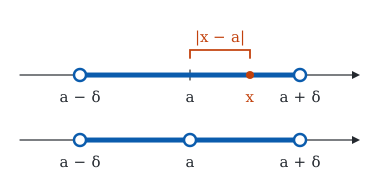
Figure 1:Top: the x with ∣x−a∣<δ form the open interval (a−δ,a+δ);
the bracket marks the distance ∣x−a∣ from a to one such x. Bottom: the x with
0<∣x−a∣<δ form the punctured neighbourhood
(a−δ,a)∪(a,a+δ); the hollow dot at a shows that a is left out.
The case a=0 is used so often that it is worth stating on its own:
∣y∣<δ if and only if −δ<y<δ, and
∣y∣≤δ if and only if −δ≤y≤δ.
The second result says that the size of a sum is at most the sum of the sizes. Part (b) is the
form for distances: going from x to y by way of z is never shorter than going directly.
These are equal if and only if xy=∣xy∣, that is, if and only if xy≥0.
No condition on δ is needed
The proof of Proposition 1 never used the sign of δ, so the proposition
holds for every real δ. For δ<0 both sides of (a), (b) and (e) are false for
every x. For δ=0, (a) and (e) have no solutions, and (b) says that
∣x−a∣≤0 if and only if x=a. Later pages use the proposition with δ>0,
where both sides describe a genuine interval or punctured neighbourhood.
∣x∣=x for x≥0 and ∣x∣=−x for x<0; ∣x−a∣ is the distance
between x and a.
∣x−a∣<δ if and only if a−δ<x<a+δ, and likewise with ≤
(Proposition 1).
“Outside” conditions, ∣x−a∣>δ, become an or: x<a−δ or
x>a+δ.
0<∣x−a∣<δ describes the punctured neighbourhood
(a−δ,a)∪(a,a+δ): the interval (a−δ,a+δ) without its
centre a (Proposition 1 (e)).
Triangle inequality: ∣x+y∣≤∣x∣+∣y∣, and
∣x−y∣≤∣x−z∣+∣z−y∣ (Theorem 1).
To solve a quadratic or rational inequality, factor, make a sign table, and check the
endpoints; never divide by a quantity whose sign you do not know.
By Proposition 1 (b) with a=0, the inequality is equivalent to
−5≤3x+1≤5. Subtracting 1 from all three parts gives −6≤3x≤4, and
dividing by 3 gives −2≤x≤34. The solution set is [−2,34].
By Proposition 1 (a), the set of x with ∣x−a∣<δ is
(a−δ,a+δ), so we need a−δ=−1 and a+δ=5. Adding the two
equations gives 2a=4, so a=2; subtracting them gives 2δ=6, so δ=3.
Check: 2−3=−1 and 2+3=5.
By Proposition 1 (c) with a=0 and δ=5, applied to y=2x−3:
2x−3<−5 or 2x−3>5. The first gives 2x<−2, so x<−1; the second gives
2x>8, so x>4. The solution set is (−∞,−1)∪(4,∞).
x2+2x−8=(x+4)(x−2), with zeros -4 and 2. For x<−4 both factors are
negative and the product is positive; for −4<x<2 the factors have opposite signs and the
product is negative; for x>2 both are positive. The inequality is strict, so the zeros are
excluded. The solution set is (−4,2).
The inequality is x3−4x≥0, and x3−4x=x(x2−4)=(x+2)x(x−2), with
zeros -2, 0 and 2. The sign table:
x<−2
−2<x<0
0<x<2
x>2
x+2
−
+
+
+
x
−
−
+
+
x−2
−
−
−
+
product
−
+
−
+
The product is positive on (−2,0) and (2,∞), and zero at the three zeros, which the
inequality allows. The solution set is [−2,0]∪[2,∞). Dividing by x at the start
would have lost the interval [−2,0].
The quotient is undefined at x=−2 and zero at x=1. For x<−2 both x−1 and
x+2 are negative, so the quotient is positive. For −2<x<1 the numerator is negative
and the denominator positive, so the quotient is negative. For x>1 both are positive. The
quotient is ≤0 on (−2,1) and at x=1, and x=−2 is excluded because the quotient
is not defined there. The solution set is (−2,1].
Here x+1=x−(−1), so a=−1 and δ=21. By
Proposition 1 (e), 0<∣x+1∣<21 means
−23<x<−1 or −1<x<−21: the interval
(−23,−21) with its centre -1 removed. The set is
(−23,−1)∪(−1,−21).
Both sides are non-negative, so by property 6 of Remark 1 the
inequality holds if and only if ∣x−1∣2<∣x+3∣2. By property 5, this is
(x−1)2<(x+3)2, that is, x2−2x+1<x2+6x+9. This
simplifies to −8<8x, so x>−1. The solution set is (−1,∞).
This matches the picture: the point halfway between -3 and 1 is -1, and the points
closer to 1 are those to the right of it.
The < comes from adding the two strict inequalities, and a ≤ followed by a < gives <.
The proof never uses the sign of δ. If δ≤0, no x satisfies
∣x−a∣<2δ, so there is nothing to prove; the statement has content only
for δ>0, which is how it is used in the Limits chapter.
By Proposition 1 (a) with a=0, ∣∣x2−4∣∣<1 means −1<x2−4<1,
that is, 3<x2<5. For x>0 this says 3<x<5, by property 6 of
Remark 1 (as 3=(3)2 and 5=(5)2), so near
2 the solutions form the interval (3,5).
By Proposition 1 (a) again, the x with ∣x−2∣<δ form
(2−δ,2+δ). This interval lies inside (3,5) exactly when
2−δ≥3 and 2+δ≤5, that is, when
δ≤2−3 and δ≤5−2.
The second bound is the smaller one: 5−2<2−3 is equivalent to
5+3<4. By property 6 of Remark 1, applied to
non-negative numbers, it is enough to compare squares: 15<4 because 15<16=42,
so (5+3)2=8+215<8+2⋅4=16=42. Here
53=15: both sides are non-negative and both square to 15, as
(53)2=5⋅3, so they are equal by the uniqueness in
the square-root remark. So every
δ≤5−2 works. If δ>5−2, then 2+δ>5, and
any x with 5≤x<2+δ satisfies ∣x−2∣<δ but x2≥5
(property 6 again),
so ∣∣x2−4∣∣≥1. The largest δ is therefore 5−2, which is 0.236
to three decimal places.