A Ferris wheel of radius 20 metres turns at a steady speed, once every 10 minutes, and its
centre is 22 metres above the ground. You board at the bottom. How high are you after 100
seconds? After 25 minutes?
Your height goes up and down between 2 and 42 metres and repeats every 10 minutes. To describe
it we need two functions that say where a point is after it has turned some way round a
circle: how far it is across, and how high. They are the cosine and the sine. The same
two functions describe everything that turns or swings back and forth: wheels and pendulums,
tides, sound waves and alternating current. We answer the question about the wheel in
Example 6.
Calculus adds one requirement: an angle is measured by a length, the length of an arc of a
circle of radius 1. This unit, the radian, is what makes the formulas of calculus for sine
and cosine simple, and this page builds everything on it.
Everything on this page rests on a few facts of plane geometry that you know from school: they
are the starting point, not something this course proves. They are used directly in these
places, and through them by every example and exercise:
the definitions of the radian (Definition 1) and of sine and cosine
(Definition 2), and the arc rθ and the sector 21r2θ on a circle
of radius r after them;
the reasons for the properties in Remark 2, and the
“In words” of Definition 3 (the line through O and P(t));
the Values bullet of Graphs: period, amplitude and phase;
the worked examples on a wheel (Example 1) and on the Ferris wheel
(Example 6);
the exercises on a pendulum (Exercise 2), on solving
sint=−21 (Exercise 7, its hint and solution) and on
the Ferris wheel (Exercise 9, its solution).
They use only the facts in the box below.
To measure an angle at the centre of the unit circle, walk along the circle, inside the angle,
from one arm to the other and measure how far you went. The larger the angle, the longer the
walk.
In words. An angle of θ radians is the angle you turn through while you walk a
distance θ along the unit circle. Radians are lengths divided by the radius, so the unit
is usually left out: “an angle of 2” means 2 radians.
Example. A full turn is the whole circle, 2π radians. A straight angle is half of it,
π, and a right angle is a quarter, 2π (property 1 of
Remark 2 shows that the quarter circles have equal
lengths). A full turn is also 360 degrees, so 1 degree is 3602π=180π
radians: 60 degrees is 18060π=3π radians, and an angle of θ
radians is π180θ degrees.
Non-example. An angle of 1 radian is not 1 degree. It is the angle whose arc is exactly
as long as the radius, π180≈57.3 degrees.
On a circle of radius r, an angle of θ radians at the centre, with
0<θ≤2π, cuts off an arc of length rθ and a sector of area
21r2θ, by the facts on circles of other radii and on areas. For θ=2π
these are the circumference 2πr and the area πr2 of the whole disc.
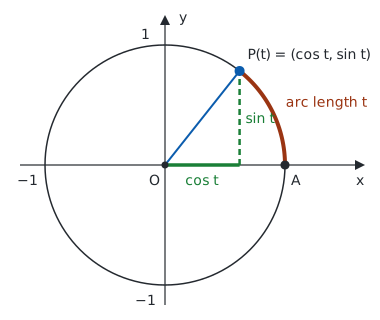
Now let the angle grow beyond a full turn, and let it turn the other way too. Start at
A=(1,0) and walk along the unit circle; after a distance t you are at a point P(t). Its
coordinates are the cosine and the sine of t.
Figure 1:The point P(t) is reached from A=(1,0) by walking a distance t along the unit circle.
Its x-coordinate is cost and its y-coordinate is sint.
In words.cost is how far across, and sint how high, you are after walking a
distance t round the unit circle from A. For 0<t<2π they are the two legs
of the right-angled triangle with hypotenuse OP(t) in
Figure 1, which is the definition from school (“adjacent over
hypotenuse” and “opposite over hypotenuse”, with hypotenuse 1). The unit circle extends it to
every real number t, and t is always in radians.
Example.P(0)=A=(1,0), so cos0=1 and sin0=0. After a quarter of the
circle, P(2π)=(0,1), so cos2π=0 and
sin2π=1 (property 1 below).
Non-example.sin30 is not 21. The number 30 is a distance along the unit
circle, almost five full turns, and sin30≈−0.988. The angle of 30 degrees is
6π radians, and sin6π=21
(Example 2).
Reflecting and rotating the circle moves P(t) to other points P(…) in a predictable
way. These properties do most of the work on this page.
Property 4 says that cos is even and sin is odd: their common
domain R is symmetric about 0. Properties 5–7 move any t into the first quadrant, so
the values there decide all the others.
Two more pairs of functions are built from sin and cos.
In words.tant is the slope of the line through O and P(t): the rise sint
divided by the run cost. When cost=0, that line meets the vertical line x=1 at
the point (1,tant), which is P(t) with both coordinates multiplied by
cost1. The other three are reciprocals: sect=cost1,
csct=sint1, and cott=tant1 wherever both are defined.
Remark 3 finds the t where cost or sint is
0.
Example.P(0)=(1,0) gives tan0=10=0 and sec0=1.
Non-example.tan2π is not a number, and not “infinity” either: by property 1,
cos2π=0, so 2π is not in the domain of tan. Likewise cot0
and csc0 are undefined, because sin0=0.
Since P(t) lies on the unit circle, its coordinates satisfy the equation of the circle. This
is the most used identity of trigonometry.
Where cost=0, the number cos2t is positive, and dividing the identity by it gives
1+tan2t=sec2t.
The next three facts are the ones that the page The Limit of a Function uses about sin, with
t in radians.
By Proposition 1, 1 is the largest value of sin, so these are maxima of
sin. The converse of Proposition 2 holds too: sin is zero only at
the multiples of π.
How do sin and cos of a sum depend on the summands? Not by adding: sin(s+t) is not
sins+sint (for s=t=2π the left side is sinπ=0 and the right
side is 2). The answer mixes sines and cosines.
We compute the distance between P(s) and P(t) in two ways: directly, and after a rotation
that moves P(t) to A. This gives (a), and the others follow from (a) and the properties of
P(t).
(a) By property 2 of Remark 2 with α=−t, a
rotation about O that maps A to P(−t) maps P(t) to P(0)=A and P(s) to P(s−t).
A rotation keeps distances (the facts from school), so the distance from P(s) to P(t)
equals the distance from P(s−t) to A, and so do their squares. By the distance formula
and Theorem 1, the first squared distance is
(d) Apply (c) to s and −t, and use property 4 as in (b).
(e) and (f): put s=t in (c) and (b). The other two forms of (f) follow from
Theorem 1: cos2t−sin2t=cos2t−(1−cos2t)=2cos2t−1,
and in the same way =1−2sin2t.
Parts (e) and (f) are the double-angle formulas. With the values of the next section they
give exact values such as cos12π (Example 5).
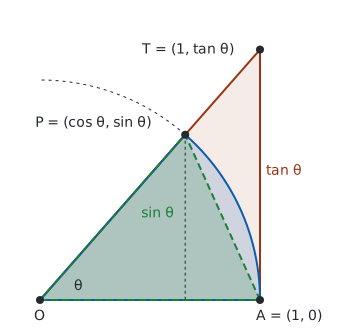
For a small positive angle θ, the height sinθ of P(θ), the arc θ
and the height tanθ of the point where the line OP(θ) meets the line x=1 are
three lengths that are almost equal. The next lemma puts them in order. It is the one fact
about sine on which the limit of xsinx, and so all of the calculus of sine and
cosine, will rest, so its proof uses no derivatives and no limits: only areas.
Figure 2:For 0<θ<2π: the triangle OAP (area 21sinθ) lies inside
the sector OAP (area 2θ), which lies inside the triangle OAT (area
21tanθ).
The proof used no derivatives and no limits. It rests directly on these facts from school:
the equation of the unit circle and of the disc, and that the disc contains the segment
between any two of its points;
journeys and arcs: the arc from A to P(θ) traced by the journey has length
θ;
that the region between two radii whose arc is shorter than half the circle contains the
segment between any two of its points, and that the triangle OAT is the part of that region
with x≤1;
that every point of the triangle OAP lies on a segment from O to a point Q of its side
AP;
the area 21bh of a triangle, and the area 2θ of a sector (so the
unit disc has area π, Archimedes’ theorem);
that a region inside another has at most its area.
Through property 8, the Pythagorean identity and parts (e) and (f), it also rests on the rest of
the box: the lengths of arcs, journeys along the circle, reflections and rotations. This course
proves none of these facts (Real Analysis does). Two of them hide a limit: the length of an arc
and the area of a sector.
At θ=4π the lemma gives a first bound on the number π itself, with no
decimals.
In words. Doubling gives 42<2π<8: the circle, of length 2π, is longer
than the square inscribed in it, whose perimeter is 42, and shorter than the square
drawn around it, whose perimeter is 8; so π lies between 22≈2.83 and 4.
As t grows, P(t) goes round and round the circle, and sint and cost repeat.
Period 2π. By property 3 of Remark 2,
2π is a period of sin and of cos (Definition 4). No smaller p>0 is a
period of sin: if sin(2π+p)=sin2π=1, then
cos(2π+p)=0 by Theorem 1, so
P(2π+p)=(0,1)=P(2π), and p=2kπ for an
integer k by the converse in property 3. Multiplying 2kπ=p>0 by the positive number
2π1 gives k>0 (properties 6 and 5(a) of the order
rules), so k≥1, as k is an integer; and multiplying k≥1
by the positive number 2π gives p≥2π
(property 5(b) of the order rules). The same argument at t=0 shows it for cos. So 2π is the period of
sin and of cos.
Values. The values of sin and cos fill the interval [−1,1]: they lie in it by
Proposition 1, and every y∈[−1,1] is a value of sin. Indeed y2≤1
(for y≥0 by the order part of the square-root remark, and for
y<0 by the same applied to −y, which lies in (0,1] because multiplying
−1≤y<0 by the negative number −1 reverses both inequalities,
property 5(c) of the order rules), so 1−y2≥0 (adding −y2, property 3 of the order rules) and
the point (1−y2,y) lies on the unit circle. By the facts from school
(journeys along the circle) it is P(t) for some t; then sint=y. In the same way, the
point (y,1−y2) shows that y is a value of cos.
Shape. On [0,2π] the graph of sin takes the values 0, 1, 0, −1 and 0 at
0, 2π, π, 23π and 2π (property 1), and then repeats; in between,
the widget below shows a smooth wave. By property 6, cost=sin(t+2π) (apply 6 to
−t and use 4: sin(2π−(−t))=cos(−t)=cost), so the graph of
cos is the graph of sin shifted 2π to the left.
Stretching and shifting the graph of sin gives every wave of the same shape. For numbers
a>0, b>0, c and d, the function
amplitudea: its values fill [d−a,d+a], because those of sin fill [−1,1],
and multiplying −1≤u≤1 by the positive number a and then adding d keeps both
inequalities (properties 5(b) and 3 of the order rules);
periodb2π: shifting x by p shifts b(x−c) by bp, and as
b(x−c) runs through all real numbers when x does, p is a period of f exactly when
bp is a period of sin; the smallest such bp is 2π;
phase shiftc: its graph is that of asin(bx)+d shifted c to the right;
midliney=d: the wave swings between d−a and d+a, about the line y=d.
Figure 3:Graph of y=asin(b(x−c))+d for −7≤x≤7, with four sliders: a
from 0.5 to 3 in steps of 0.5, b from 0.5 to 4 in steps of 0.5, c from −3 to
3 in steps of 0.25, and d from −2 to 2 in steps of 0.5. It starts at a=1,
b=1, c=0 and d=0, with the graph of y=sinx: a wave between −1 and 1
that crosses the x-axis at the multiples of π≈3.14 and repeats every
2π≈6.28. Increasing a stretches the wave vertically, increasing b squeezes it
horizontally, increasing c shifts it to the right, and increasing d shifts it up.
Try this:
Set b=2. How many complete waves fit between 0 and 2π≈6.28 now? What is
the period?
Set b=1 again and move c to −1.5, the slider’s closest value to
−2π≈−1.571. The graph is now y=sin(x+1.5). Which function from
this page does it almost match, and which value of c, not on the slider, would match it
exactly? (Look at the shape bullet above.)
Set c=0, a=3 and d=2. Between which heights does the wave swing, and where is its
midline?
In degrees, the angle that cuts off an arc of length θ is π180θ, so the
“sine in degrees” is s(x)=sin180πx. Then Lemma 1 would read
s(x)<180πx<tan180πx for 0<x<90: the sine is no longer
compared with the angle x itself, but with 180π times it. In the same way, with
θ=180πx,
so every statement about θsinθ carries the factor 180π when
it is written in degrees. Radians are the unit in which the length of the arc is the angle,
and no such factor appears.
Defining sine without pictures
Definition 2 rests on the length of an arc, and Lemma 1 on the area of
a sector. Both are limits in disguise (the length of a curve is a limit of the lengths of
inscribed polygons), so a fully rigorous treatment must define them first. There are two
standard ways round this. One defines sin and cos by power series and proves every
property on this page from the series; the number π is then defined as twice the smallest
positive zero of cos. The other defines the area of a sector as an integral and the angle
from it. Either way, the facts from school become theorems. The course takes them as known
here, and the order of the pages makes sure that they are never “proved” by a result that rests
on them; that construction belongs to Real Analysis (ana).
An angle in radians is the length of the arc it cuts off on the unit circle: a full turn
is 2π, and 180 degrees is π. On a circle of radius r, the arc is rθ and the
sector 21r2θ.
P(t)=(cost,sint) is the point reached by walking a distance t from (1,0) round
the unit circle, anticlockwise for t>0 (Definition 2); tant=costsint.
Reflections and rotations of the circle give the symmetries
(Remark 2): period 2π, cos even, sin odd, and
values in any quadrant from values in the first.
cos2t+sin2t=1; −1≤sint≤1; sin(kπ)=0 and
sin(2π+2kπ)=1 for every integer k.
Addition formulas: sin(s+t)=sinscost+cosssint and
cos(s+t)=cosscost−sinssint.
For 0<θ<2π: sinθ<θ<tanθ, by comparing areas, with
no derivatives (Lemma 1).
asin(b(x−c))+d (with a,b>0) has amplitude a, period b2π,
phase shift c and midline y=d.
The tip moves along a circle of radius r=0.8 about the point where the pendulum hangs, and
the angle at the centre is θ=0.3 radians. On a circle of radius r an angle of
θ radians cuts off an arc of length rθ (Radian and the facts
on circles of other radii), so the tip travels 0.8⋅0.3=0.24 metres.
(a) By Theorem 1, sin2t=1−16925=169144.
For the sign, let u=t−π; subtracting π from π<t<23π keeps both
inequalities (property 3 of the order rules) and gives
0<u<2π. By property 7 of Remark 2,
sint=sin(u+π)=−sinu, and sinu>0 by property 8. So sint<0, and
−sint is the non-negative number whose square is 169144, namely 1312
(the square-root remark). So sint=−1312.
sint=−21 means that P(t) is a point of the unit circle with y=−21. For such
a point, x2=1−41=43, so x=23 or x=−23
(the square-root remark). So there are exactly two such points, and
each is P(t) for exactly one t in [0,2π) (the facts from school). We find those t
with Remark 2 and
Example 2:
(−23,−21): by property 7,
P(6π+π)=(−cos6π,−sin6π), which
is this point, and 67π lies in [0,2π).
(23,−21): by property 4,
P(−6π)=(cos6π,−sin6π), which is this
point, and by property 3 it is also P(−6π+2π)=P(611π),
with 611π in [0,2π).
So the solutions in [0,2π) are t=67π and t=611π.
The function is asin(b(x−c))+d with a=2, b=3, c=0 and d=1. In the
widget, the wave swings between −1 and 3, and about three waves fit between 0 and
2π≈6.28.
h(t)=32 means 20cos5πt=−10, that is, cosu=−21 with
u=5πt. Multiplying 0≤t<10 by the positive number 5π keeps
both inequalities, and dividing by it (multiplying by π5, which is positive) does
too (properties 5 and 6 of the order rules), so as t runs through [0,10), u runs through [0,2π).
The points of the unit circle with x=−21 have y2=1−41=43, so they are
(−21,23) and (−21,−23)
(the square-root remark). Each is P(u) for exactly one u in
[0,2π) (the facts from school). With the values of
Example 2:
property 5 of Remark 2 gives
P(π−3π)=(−21,23), so u=32π;
property 7 gives P(3π+π)=(−21,−23), so
u=34π.
Then t=π5u gives t=310 and t=320: after
331 minutes on the way up and after 632 minutes on the way down.
Now 0≤v<u≤π gives 0<u+v<2π: adding 0≤v and 0<u gives
0<u+v, and adding v<π and u≤π gives u+v<2π (property 4 of the order
rules: adding two inequalities, one of them strict, gives a strict one).
Multiplying by the positive number 21 keeps both inequalities (property 5(a) of the
order rules), so 0<m<π. Also,
subtracting v keeps v<u and u≤π (property 3 of the order rules), so 0<u−v
and u−v≤π−v; and π−v≤π, because multiplying 0≤v by −1 gives
−v≤0 (property 5(c)) and adding π keeps that (property 3). So 0<u−v≤π;
multiplying by the positive number 21 gives 0<d≤2π<π. By property 8 of
Remark 2, sinm>0 and sind>0. So
cosv−cosu=2sinmsind>0, that is, cosv>cosu. As v<u in [0,π] were
arbitrary, cos is strictly decreasing on [0,π].
π is a period. Let t∈domtan, so cost=0. By property 7 of
Remark 2, cos(t+π)=−cost=0, so
t+π∈domtan, and
tan(t+π)=cos(t+π)sin(t+π)=−cost−sint=tant.
No smaller period. Let p>0 be a period of tan. Since 0∈domtan (cos0=1),
Definition 4 gives p=0+p∈domtan and tanp=tan0=0. So
cospsinp=0, and multiplying by cosp=0 gives sinp=0. By
Remark 3, p=kπ for an integer k. Multiplying kπ=p>0
by the positive number π1 gives k>0
(properties 6 and 5(a) of the order rules), so k≥1, as k is an
integer. Multiplying k≥1 by the positive number π gives p≥π
(property 5(b) of the order rules). So π is the period of tan (Definition 4).
Multiplying θ<cosθsinθ by the positive number
θcosθ keeps it too: cosθ<θsinθ.
Now let −2π<θ<0, and ϕ=−θ, so that 0<ϕ<2π.
By property 4, cosθ=cosϕ and sinθ=−sinϕ, so
θsinθ=−ϕ−sinϕ=ϕsinϕ. The first part,
for ϕ, gives cosϕ<ϕsinϕ<1, which is the claim for θ.
Found an error on this page? Report it (the form opens with this page filled in).
The page The Squeeze Theorem traps xsinx between cosx and 1, as in
Exercise 12, and finds its limit at 0; from it come the
derivatives of all six trigonometric functions.