Calculus is about quantities that change without jumps: the position of a car, the
temperature of a cup of coffee, the area under a curve. To describe them we need a number
system with no gaps, and fractions are not enough.
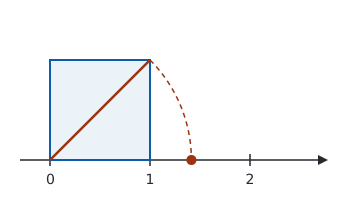
Draw a square whose sides have length 1. By Pythagoras’ theorem its diagonal d satisfies
d2=12+12=2. Is d a fraction? We prove below that it is not: no fraction squares to
2. Yet the diagonal certainly has a length, and swinging it down onto the number line marks
a definite point on it. The real numbers are the number system in which every point of the
line is a number, and so every length is one.
Figure 1:The diagonal of the unit square has length 2. Swung down onto the number line, it
marks a point between 1 and 2 that no fraction reaches.
The second half of this page is a language for sets of real numbers. Calculus keeps asking
for whichx something holds: x−1 is defined exactly when x≥1, and a
function may increase only for x between two values. Intervals and set-builder notation say
such things briefly and precisely.
Every integer n is rational, because n=1n. The number 2 is irrational
(Theorem 1 below), and so is π, although that proof is harder and we
do not need it.
Decimals. Every real number has a decimal expansion, such as 41=0.25,
31=0.333… or 2=1.41421…. A bar marks a block of digits that
repeats for ever: 0.3=0.333… and 0.125=0.1252525…. The
decimals tell rational and irrational numbers apart:
The decimal expansion of a rational number qp terminates or eventually repeats.
When we divide p by q by long division, each remainder is one of 0,1,…,q−1, so
after at most q steps a remainder comes back, and from then on the digits repeat.
Conversely, a decimal that terminates or eventually repeats is rational:
Example 3 shows the method.
So the irrational numbers are exactly the real numbers whose decimals go on for ever without
repeating. A decimal approximation such as 2≈1.4142 is a rational number close
to 2, never 2 itself.
Order. For any two real numbers a and b, exactly one of a<b, a=b and a>b
holds; on the number line, a<b means that a lies to the left of b. We write a≤b
for “a<b or a=b”.
Every inequality on this site rests on the rules below. Four of them are axioms of the
order: like the rules of arithmetic, we take them as defining properties of R (the rigorous
track says more in Remark 5). The others follow from the axioms, and
each comes with its reason.
A set is a collection of objects, its elements. We write x∈A for “x is an
element of A” and x∈/A for its negation. A small set can be listed in braces, as in
{1,2,3}. Most sets in calculus are described by a condition instead, in set-builder
notation:
is read “the set of all real numbers x such that x>0”. The empty set∅ has
no elements. For sets A and B:
Notation
Read as
Its elements
A⊆B
A is a subset of B
every element of A is an element of B
A∩B
A intersect B
the x with x∈Aandx∈B
A∪B
A union B
the x with x∈Aorx∈B (or both)
A∖B
A minus B
the x with x∈A and x∈/B
The sets of real numbers that calculus uses most are intervals: all the numbers between two
endpoints, or all the numbers on one side of a point.
In words. A square bracket means that the endpoint belongs to the interval, a round bracket
that it does not. The symbols ∞ and −∞ are not real numbers: they only say that
the interval has no end on that side, so they always get a round bracket. We ask for a<b so
that every interval contains more than one number.
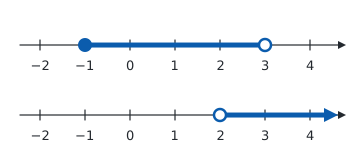
Example.{x∈R:−1≤x<3}=[−1,3) contains −1, 0, 2.9 and 2,
but not 3. On the number line we draw the included endpoint as a filled dot and the excluded
one as a hollow dot (Figure 2).
Figure 2:The interval [−1,3) (top): the filled dot shows that −1 belongs to it, the hollow dot that
3 does not. The interval (2,∞) (bottom) starts just after 2 and has no right end.
Non-example. An interval has no gaps: if two numbers lie in an interval, so does every
number between them. The set {x∈R:x=0} is therefore not an interval: it contains
−1 and 1 but not 0, which lies between them. It is the union (−∞,0)∪(0,∞)
of two intervals. The set Z of integers is not an interval either: it contains 1 and 2 but
not 1.5.
Here, as in Remark 2, we have taken from school that 2 exists: that
there is a positive real number whose square is 2. The rigorous track shows that this is
exactly what the completeness of R guarantees, and what Q lacks, and proves
Remark 2 for every y≥0.
What makes R different from Q? Both allow the four arithmetic operations, and both are
ordered. The difference is that R has no gaps, and to say this precisely we need upper bounds
and suprema.
In words. An upper bound lies on or to the right of every element of S. For example 1,
2 and 100 are upper bounds of [0,1), and 0.9 is not, because 0.95∈[0,1). Lower
bounds and bounded below are defined in the same way with s≥u, and a set is bounded
if it is bounded above and below.
In words. The supremum is the smallest upper bound. It need not belong to S:
sup[0,1)=1, because 1 is an upper bound and every number u<1 fails to be one (the
number max(0,2u+1) lies in [0,1) and is larger than u). A useful
consequence: if s=supS and ε>0, then s−ε is smaller than s, so it is not an
upper bound, and some element x∈S satisfies x>s−ε.
Why “non-empty”. Every real number is an upper bound of the empty set, since ∅ has
no element to check. So ∅ is bounded above, but its upper bounds are all of R, which
has no smallest element: ∅ has no supremum. A set that is not bounded above, such as
R itself, has no upper bound at all, so no supremum either.
Three first consequences of completeness. The first, that N is not bounded above, is the
Archimedean property of R; later pages cite it by that name.
Completeness gives 2
Let S={x∈R:x≥0 and x2<2}. It is non-empty (1∈S) and bounded
above by 2 (if x≥2 then x2≥4). By Axiom 1 it has a supremum
s, and 1≤s≤2. We show that s2=2 by ruling out the other two cases.
If s2<2: let h=2s+22−s2. Then 0<h<1, because
0<2−s2<2<2s+2 (the first by the case we are in, the others because s≥1).
So h2<h and (s+h)2=s2+2sh+h2<s2+h(2s+2)=2. So s+h∈S,
although s+h>s: this contradicts s being an upper bound.
If s2>2: let h=2ss2−2. Then h>0, s−h=2ss2+2>0
and (s−h)2=s2−2sh+h2=2+h2>2. Every x∈S has x2<2<(s−h)2,
so x<s−h (if x≥s−h>0, then multiplying by x≥0 and by s−h>0 would
give x2≥x(s−h)≥(s−h)2). So s−h is an upper bound of S smaller than s:
this contradicts condition 2 of Definition 3.
Hence s2=2: the supremum s is the positive square root of 2.
The gap in Q. The set SQ={x∈Q:x≥0 and x2<2} is non-empty
and bounded above, but no rational number u is its least upper bound among the rationals.
Suppose one were. Then u≥1 (because 1∈SQ), and u2=2 by
Theorem 1. If u2<2, the first case above with s=u gives a rational
h and an element u+h of SQ larger than u. If u2>2, the second case gives the
rational upper bound u−h=2uu2+2 of SQ, smaller than u. Both contradict
the choice of u. So the argument that produced 2 in R fails in Q at its very
first step: there, the supremum need not exist.
Completeness gives every square root
We prove Remark 2: every y≥0 has exactly one non-negative square root,
and for s,t≥0, s<t⟺s2<t2.
Order and uniqueness. If 0≤s<t, then s2<t2: multiplying s<t by s≥0
gives s2≤st, and multiplying it by t>0 gives st<t2. So two different non-negative
numbers have different squares, and y has at most one non-negative square root. In the same
way, if 0≤s≤t then s2≤t2. Conversely, let s,t≥0 with s2<t2. By
trichotomy (property 1 of the order rules: exactly one of s<t, s=t and t<s holds), it is
enough to rule out the other two. If s=t, then s2=t2; if t<s, then t2<s2
by what we just proved, with s and t swapped. Neither is compatible with s2<t2, so
s<t.
Existence (sketch). For y=0, take s=0. For y>0, we repeat the argument for
2 with y in place of 2. The set Sy={x∈R:x≥0 and x2<y}
is non-empty (0∈Sy) and bounded above by 1+y (if x≥1+y, then x≥1, so
x2≥x>y). By Axiom 1 it has a supremum s≥0.
If s2<y: let h be the smaller of 21 and 2s+1y−s2. Then
0<h<1, so h2<h and (s+h)2<s2+h(2s+1)≤y. So s+h∈Sy, although
s+h>s.
If s2>y: then s>0 (as s≥0 and s2>0); let h=2ss2−y.
As for 2, h>0, s−h=2ss2+y>0 and (s−h)2=y+h2>y.
Every x∈Sy has x2<y<(s−h)2, so x<s−h (if x≥s−h≥0, the
order step would give x2≥(s−h)2). So s−h is an upper bound of Sy smaller
than s.
Both cases contradict s=supSy, so s2=y.
One more consequence of the Archimedean property, which later
pages cite: every real number lies between two consecutive integers.
The interval (−2,3] is {x∈R:−2<x≤3}. The integer −2 is excluded (the
bracket is round) and 3 is included (the bracket is square), so the integers in it are
−1, 0, 1, 2 and 3.
A number lies in both intervals when −1≤x<4 and 2<x≤6. The larger left endpoint
is 2 and the smaller right endpoint is 4, so the conditions together say 2<x<4. The
endpoint 2 is excluded because 2∈/(2,6], and 4 because 4∈/[−1,4). So the
intersection is (2,4), as in Example 2.
The intervals overlap on (1,2], so their union has no gap: it runs from the left end of
[0,2] to the right end of (1,5). The left endpoint 0 belongs to [0,2], so it is
included; the right endpoint 5 belongs to neither interval, so it is excluded. The union is
[0,5).
The interval [1,3) is {x∈R:1≤x<3}. A real number fails this condition when
x<1 or when x≥3. The first condition gives (−∞,1), without 1 (which is in
[1,3)), and the second gives [3,∞), with 3 (which is not in [1,3)). So
R∖[1,3)=(−∞,1)∪[3,∞).
We argue by contradiction, as in the proof of Theorem 1.
We use division with remainder by 3: every integer is of exactly one of the forms 3m,
3m+1 and 3m+2 with m∈Z, and 3 divides it exactly when it is of the form 3m.
First, if 3 does not divide an integer p, then it does not divide p2. Indeed, then
p=3m+1 or p=3m+2 with m∈Z, and
which are both of the form 3j+1 with j∈Z, so neither is of the form 3m.
Suppose now that 3=qp with positive integers p and q, and choose q as
small as possible. Then p2=3q2, so 3 divides p2, and by the first paragraph 3
divides p: p=3k with k a positive integer. Then 9k2=3q2, that is q2=3k2, so
3 divides q2 and therefore q: q=3l with l a positive integer. Now
3=3l3k=lk with l<q, which contradicts the choice of q. So
3 is irrational.
(a) Let S={1−n1:n an integer,n≥1}. Every element satisfies
1−n1<1, so 1 is an upper bound. Now let u<1. By
the Archimedean property there is an integer n≥1 with
n>1−u1, and since 1−u>0 this gives n1<1−u, that is
1−n1>u. So u is not an upper bound, and every upper bound is at least 1:
supS=1. Note that 1∈/S, so S has no largest element.
(b) Let T={x∈R:x2<2}. If x≥2, then x>0, and multiplying
x≥2 by x and by 2, both positive, gives
x2≥2x≥2⋅2=2, so x∈/T; hence every element of
T is less than 2, and 2 is an upper bound. Now let u<2 be any
upper bound of T. Since 0∈T, we have u≥0. The number x=2u+2
satisfies 0≤u<x<2. Multiplying x<2 by x>0 and by 2>0
gives x2<2x<2, so x∈T; but x>u, which contradicts u being an upper
bound. So no number below 2 is an upper bound: supT=2.
Next, the integer part of na is an integer k with
k≤na<k+1. Let m=k+1. Then m is an integer greater than na, and m−1=k
is not; so m is the smallest integer greater than na, since an integer greater than na is
greater than m−1 and hence at least m. Since m−1≤na,